BtM contamination in hair: When a positive result is really meaningful
A positive result from a hair analysis can have significant consequences. This is especially true in the context of one Proof of abstinence, one MPU, labor law issues or forensic procedures. Many affected people therefore ask themselves: Means BtM in hair automatically that was consumed? Or one can external contamination of hair lead to a noticeable result?
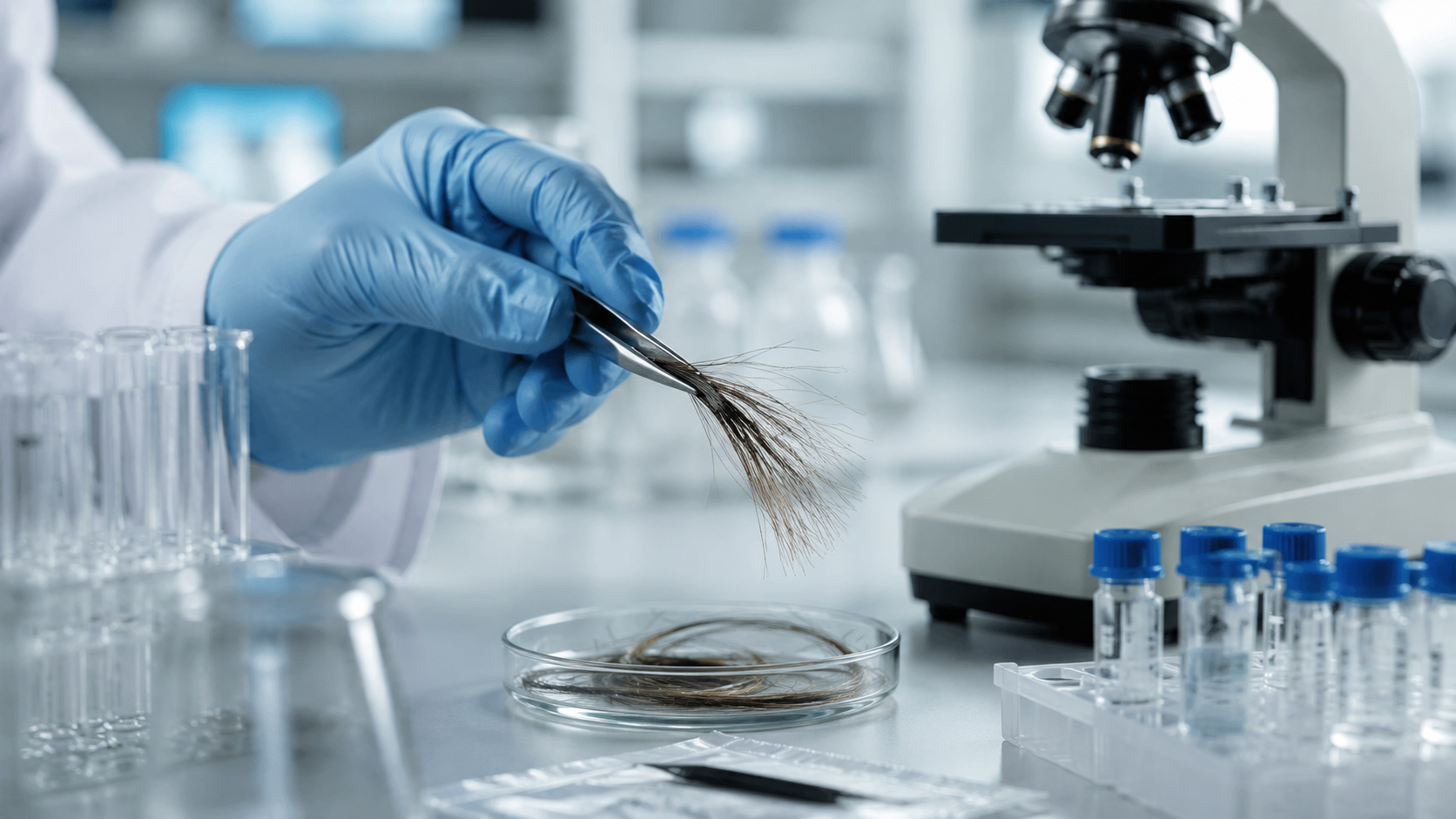
The answer is nuanced. Hair analyzes can provide valuable information, but are not free of scope for interpretation. The decisive factor is whether the detected substances can be plausibly explained by real consumption or whether a passive entry into the hair sample caused by smoke, dust, hands, sweat, surfaces or other external sources.
This article explains how BtM contamination can occur in hair and what role Metabolites in hair play and why a positive result should not always be automatically understood as proof of consumption.
What is measured in a hair analysis?
A hair analysis examines whether certain substances or their breakdown products can be detected in the hair. Hair serves as a so-called examination matrix. This means: They can contain information about past exposures or consumption events.
In the BtM context, laboratories are primarily interested in three types of substances:
| Expression | Meaning |
|---|---|
| active ingredient | The original substance, for example a narcotic or a psychoactive substance |
| Metabolite | A breakdown product that can form in the body after ingestion or consumption |
| residue | A substance that adheres to the outside and does not necessarily come from inside the body |
It is precisely this difference that is crucial. If only one active ingredient is found, this can also be explained by external influences, depending on the substance, concentration and pattern. On the other hand, they are typical Metabolites in hair proven, this can speak more strongly for absorption into the body. Nevertheless, each finding must be evaluated on a case-by-case basis.
Hair analyzes are considered sensitive in the BtM area because they do not only cover a very short period of time. Unlike blood or urine tests, hair can provide information about longer periods in the past. That’s exactly why they’re often used Hair analysis proof of abstinence used.
External Contamination: The Most Important Sources
One external contamination of hair analysis means that substances from outside get onto or into the hair without active consumption having to have taken place. Hair is not completely shielded. They constantly come into contact with air, hands, textiles, cosmetics and surfaces.
Smoke and aerosols
A frequently discussed source is smoke. Anyone who is in rooms where narcotics are consumed can come into contact with smoke particles or aerosols. These particles can deposit on hair.
Whether this results in a positive hair result depends on several factors:
- Intensity of exposure
- Duration of stay
- Ventilation of the surrounding area
- Type of substance
- Frequency of contacts
- Condition and structure of the hair
The question “Can smoke make hair positive?” therefore cannot be answered in general terms. A theoretical possibility exists, but the forensic assessment depends heavily on the specific findings.
Hands, sweat and skin contact
Hands can also play a role. Anyone who touches contaminated objects or has contact with people whose hands carry substance residues can transfer residues to hair. The same applies to sweat, skin contact or sharing textiles.
This is particularly relevant in close contact, for example in shared living spaces, vehicles or social environments with substance use.
Dust, environmental pollution and surfaces
BtM residues can occur in dust, on furniture, in vehicles or on other surfaces. If hair is regularly exposed to such environments, buildup can occur.
Typical examples are:
- polluted interiors
- contaminated clothing
- shared bedding
- Vehicle interiors
- Surfaces with substance residues
Care products and cosmetic influences
Hair care and cosmetic treatments can also complicate interpretation. Coloring, bleaching, straightening or intensive care products can change the hair structure. This means that substances can be stored, washed out or distributed differently.
This does not automatically mean that an analysis is useless. However, it shows that cosmetic influences should be taken into account in the evaluation.
Contamination vs. Consumption: Simple Examples
The difference between external contamination and internal installation can be illustrated using simple examples.
Example 1: Passive contact with smoke
A person repeatedly stays in a poorly ventilated room where other people consume BtM. Residue can be deposited externally on the hair. External contamination would be conceivable here.
Example 2: Active consumption
A person absorbs a substance themselves. The substance is processed in the body, reaches the hair root or hair via blood, sweat or sebum and can be detected there. In this case it is more likely to be referred to as internal installation.
Example 3: Contact via hands or surfaces
A person touches contaminated surfaces and then regularly touches hair or scalp. This can also cause residues to be transferred.
These examples show: A hair finding must always be considered in connection with concentration, substance pattern, metabolites, history and sample handling.
Internal installation vs. superficial attachment
When evaluating a hair sample, the key question is: Does the evidence come from inside the body or is it more of a superficial deposit?
What speaks for real consumption?
The following points, among others, can speak for real consumption:
- Detection of typical metabolites
- repeatable or consistent patterns of findings
- Concentrations that fit the claimed time period
- segmental distribution along hair growth
- Findings that cannot be plausibly explained by environmental contact alone
Metabolites are particularly important because they often only arise through physical processing. Their detection can therefore indicate actual absorption more strongly than the pure detection of an active ingredient.
Which findings are more likely to indicate contamination?
The following can indicate possible contamination:
- Conspicuous detection of active ingredients without suitable metabolites
- atypical concentration patterns
- strong strain on external parts of the hair
- Known exposure to smoke, dust, or contaminated surfaces
- Contradictions between findings and other evidence
- plausible explanation due to professional or private environment
What is important is that no single criterion always decides alone. The evaluation is usually carried out on the basis of several indications.
Typical sources of contamination and their relevance
| Source of contamination | Possible entry | Relevance for the assessment |
|---|---|---|
| Smoke and aerosols | Deposit on hair surface | Particularly relevant for repeated or intense exposure |
| Hands and skin contact | Transfer of residues | Relevant for close contact or frequent touching of hair |
| Dust and indoor air | Particles are deposited on hair | Relevant in polluted interiors |
| Contaminated surfaces | indirect transfer via hands, clothing or textiles | Relevant for regular contact |
| Sweat and sebum from other people | Transmission through close physical contact | Depending on the individual case |
| Care products | Change in hair structure or entry of residue | May influence analysis and interpretation |
| Cosmetic treatment | Washing out, damage or alteration of the hair material | Important for laboratory evaluation |
How laboratories assess contamination
Forensic toxicology laboratories attempt to external contamination to be distinguished from internal installation. Various criteria are used for this.
Washing steps
Before the actual analysis, hair samples are often washed. The aim is to remove surface residues as much as possible. Washing solutions can also be examined to obtain evidence of external buildup.
However, washing does not mean that all contamination is completely removed. Some substances can bind more strongly to hair structures or penetrate damaged hair areas.
Concentration patterns
Laboratories not only look at whether a substance is present, but also in what concentration. Very low-level, atypical, or isolated findings may be evaluated differently than clear, consistent patterns.
Ratio of active ingredient to metabolites
A particularly important point is the relationship between active ingredient and metabolites. If an active ingredient is detectable, but expected metabolites are missing or only occur in very unusual proportions, contamination can be discussed.
Limits of laboratory diagnostic significance
Modern analytics also have limits. A laboratory finding is a strong indication, but not always a complete answer to the question of how a substance got into the hair. Therefore, findings should always be interpreted in context.
This includes:
- Exposure information
- Sampling
- Hair length and segmentation
- cosmetic treatment
- other laboratory values
- medical and legal issues
When a hair finding becomes legally sensitive
A positive hair finding can have significant legal or administrative implications. This is particularly relevant for MPU, for proof of abstinence or in forensic procedures.
Proof of abstinence
Proof of abstinence is intended to prove that no consumption has taken place over a certain period of time. A positive result can jeopardize this proof. This makes professional interpretation all the more important.
MPU context
Hair analyzes can play an important role in the MPU context. A positive result can raise doubts about abstinence. However, it should not be hastily assumed that every positive result necessarily proves active consumption.
Forensic assessment
In forensic toxicology, it’s not just the evidence itself that counts. What is crucial is whether the finding is reliable, plausible and can be interpreted in the context of other circumstances.
A positive hair result can be an indication. However, it does not automatically replace the legal examination of the individual case.
Why a positive result does not automatically prove consumption
The statement “positive means consumed” is too simple. A positive hair result can indicate consumption, especially if there are suitable metabolites and consistent concentration patterns. But there are situations where external contamination also needs to be seriously considered.
This is especially true if:
- the person concerned plausibly reports no consumption
- external sources of stress are documented
- Metabolites are missing or atypically low
- other tests were negative
- the finding is isolated or contradictory
OneHair analysis negative despite contaminationis also possible if residues are removed by washing steps, the exposure was too low or the detection limits were not reached. Conversely, contamination can lead to abnormal findings under certain conditions.
Typical misunderstandings when it comes to hair analysis
“Positive always means consumed.”
That’s wrong. A positive finding can indicate consumption, but must be assessed in context.
“Washing dissolves any residue.”
That too is too general. Washing steps reduce external residues, but do not necessarily completely remove all deposits.
“A single finding is enough evidence.”
A single finding can be important, but should not be viewed in isolation. Other circumstances, laboratory parameters and legal requirements are crucial.
“Drug-specific contamination is always easy to detect.”
Not always. The distinction between contamination and consumption can be complex, especially at low concentrations or unclear exposure situations.
Practical tips to avoid contamination
Anyone who needs a hair analysis to prove abstinence or to address a legal issue should avoid possible sources of contamination as much as possible.
Useful measures are:
- Avoid contact with rooms with BtM consumption
- Avoid smoke, aerosols and polluted interior spaces
- Keep hands and surfaces clean
- Do not use other people’s hairbrushes, hats or textiles
- Clarify cosmetic treatments with the laboratory in advance
- Document relevant exposures
- Pay close attention to laboratory instructions for taking samples
Documentation is particularly important. Anyone who comes into contact with possible sources of exposure professionally, privately or through their living environment should record this in a comprehensible manner.
Limitations of hair analysis in a legal context
Hair analysis is an important tool, but it is not a substitute for a full legal evaluation. Particularly in the event of a dispute, it is important whether the findings were collected methodically correctly, documented in a comprehensible manner and interpreted in a technically reliable manner.
Relevant questions may include:
- Was the sample taken properly?
- Was the hair sample segmented?
- Which substances and metabolites were found?
- What concentrations were there?
- Have washing solutions been taken into account?
- Are there plausible sources of contamination?
- Are there any other negative or positive findings?
- Which legal requirements apply in the specific procedure?
If in doubt, a secondary toxicological or legal assessment may be useful.
FAQ: Frequently asked questions about BtM contamination in hair
Can passive exposure make hair positive?
Yes, passive exposure can lead to residue on hair under certain circumstances. Whether this results in a relevant positive finding depends on the intensity, duration, substance, environment and laboratory assessment.
How does a laboratory detect contamination?
Laboratories check, among other things, washing steps, concentration patterns, substance profiles and the ratio of active ingredient to metabolites. The distribution in the hair can also provide clues.
Is a hair analysis enough proof of consumption?
A hair analysis can be a strong indication, but does not always automatically prove active consumption. Particularly in the case of possible sources of contamination, the findings must be classified technically and legally.
What role do metabolites play?
Metabolites are breakdown products that are often formed in the body after a substance has been absorbed. Their evidence can speak more strongly for real consumption than the pure evidence of an active ingredient. Nevertheless, it’s the big picture that matters.
How long do BtM remain detectable in hair?
This depends, among other things, on hair length, growth rate, substance, consumption pattern and the aim of the examination. An average hair growth of around one centimeter per month is often used. However, the specific assessment should be carried out by a qualified laboratory.
Can a hair analysis be negative even though contamination has occurred?
Yes. If exposure was low, residues were removed, or detection limits were not reached, a hair analysis may be negative even though external contact occurred.
What should you consider before a hair analysis?
Laboratory procedures should be followed closely, potential sources of contamination avoided, and relevant exposures documented. Cosmetic treatments should be specified in advance.
Conclusion: How to correctly classify hair results
One BtM contamination in hair is generally possible and can make the interpretation of a hair analysis difficult. At the same time, a positive hair result, especially if there are suitable metabolites and consistent concentration patterns, can be a relevant indication of actual consumption.
It is therefore not just the question of whether a substance has been detected that is crucial. What is important is the overall pattern of findings, the laboratory assessment, possible sources of contamination and the legal context.
Especially when it comes to proof of abstinence, MPU questions or forensic procedures, a positive result should not be judged too quickly. A technical and, if necessary, legal examination in individual cases is often crucial.