MPU after bike & alcohol?
Bicycles and alcohol don’t mix. Cyclists are also full participants in road traffic. Anyone who cycles drunk risks penalties, points, driving bans – and even their driving license. It becomes particularly critical when blood alcohol levels are high. The authority then often orders an MPU. It doesn’t matter whether you are traveling by car, e-bike or bicycle. The decisive factors are limit values, failure symptoms and the individual case. This guide explains the legal situation, typical scenarios, the MPU steps and your options for abstinence or controlled drinking.
The most important thing in brief
- Alcohol limits also apply on bikes; away 1.6‰ Absolute driving impairment is punishable and regular MPU applies.
- Already from 0.3‰ There are consequences if driving errors or accidents occur (relative inability to drive).
- E-scooters are treated like motor vehicles: from 0.5‰ Administrative offence, off 1.1‰ crime.
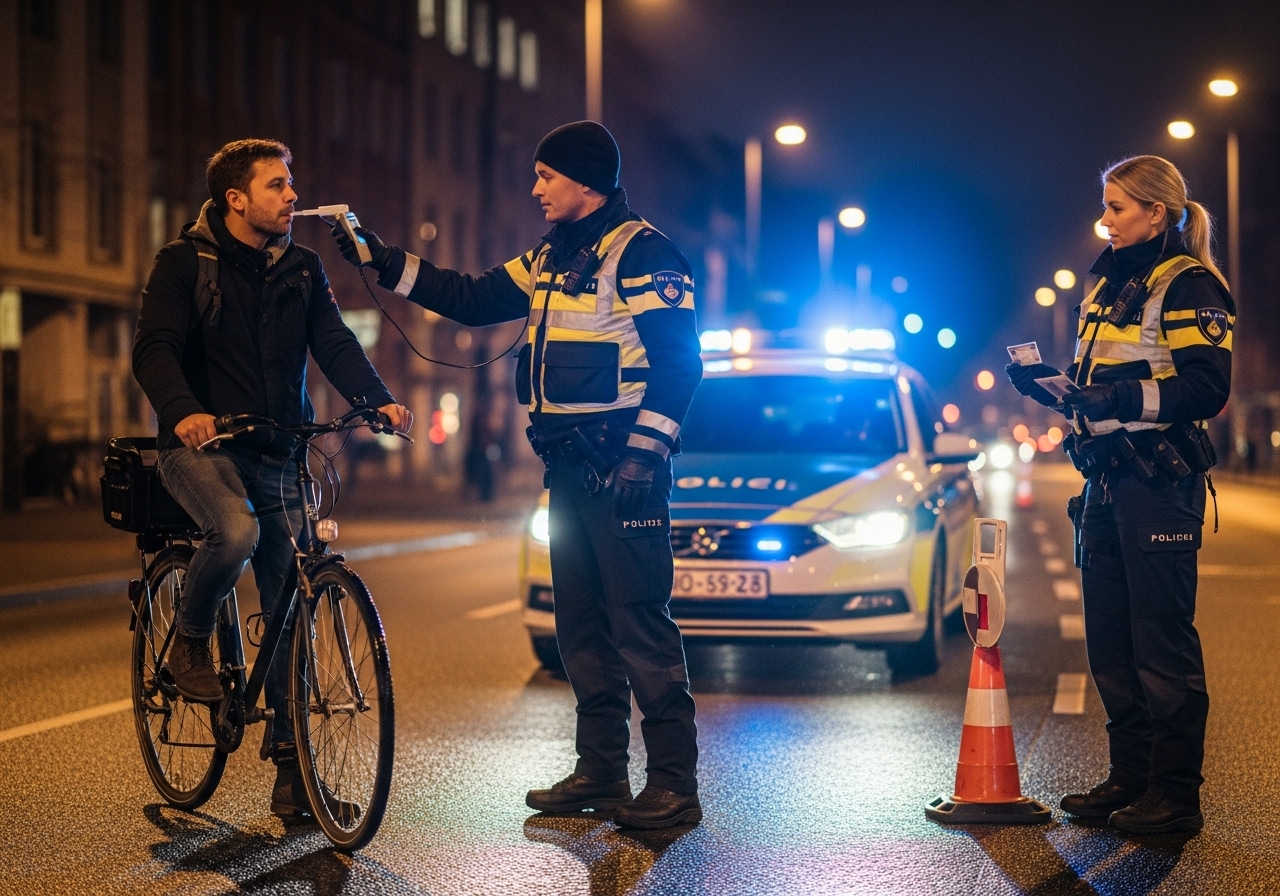
- The police are allowed to Offer a breath test; The proof comes at the end Blood sample. “Blowing” is voluntary; blood sampling can be ordered if there is suspicion.
- MPU after bicycle offenses is like driving: medicine, performance, psychology; often with proof of abstinence or a stable consumption concept.
Can my driver’s license be revoked for drinking while riding my bike?
Yes. Away 1.6‰ Cyclists are considered absolutely unfit to drive; There is a risk of criminal proceedings, points and the like regular MPU arrangement by the driving license authority – with effects on the car driving license. Under 1.6‰ Sensitive measures are also taken in the event of failures, accidents or repeat offenses.
Alcohol limits and consequences at a glance
| Vehicle type | 0.0–0.29‰ | 0.3–0.49‰ | 0.5–1.09‰ | 1.1–1.59‰ | ≥1.6‰ |
|---|---|---|---|---|---|
| Bicycle | i. d. R. without consequences | Consequences of failure/accident (relatively unfit to drive) | – | Criminal offense possible if serious failures occur | Absolute inability to drive, offense, points, MPU usually |
| E-scooter (vehicle) | for U21/probationary period 0.0 | – | OWi: €500, 1 month driving ban, 2 points (normal case) | crime (from 1.1‰) | crime; regular MPU |
| Car/motor vehicle | – | – | OWi (without abnormalities) | Absolute inability to drive from 1.1‰ | – |
Sources: ADAC, overviews of fines/case law, § 316 StGB.
Legal situation: Why cycling + alcohol is so risky
Traffic rules also apply on bicycles. This is not just in the law, but follows from the logic of road traffic. Anyone who takes part in traffic must be able to drive. Alcohol reduces reaction, overview and balance. Even small mistakes are an indication of relative inability to drive. This applies, for example, to serpentine lines. This also applies when driving through red lights.
Or when changing lanes at risk. From a blood alcohol concentration of 1.6‰ Jurisprudence assumes absolute inability to drive. Then no further proof of failure symptoms is necessary. A crime has occurred. Points and fines follow. The driving license authority also checks your fitness to drive. She can do that MPU trigger. E-scooters also fall under stricter limits because of their classification as motor vehicles. That’s why “Plan B bike or scooter” ends up being harder than expected.
Police check: breath test, blood sample and evidence
Police checks happen mainly on weekends. Suspicions include driving errors, a fall or the smell of alcohol. The police may offer the breath alcohol test. The test is voluntarily. Nobody has to blow. This is important to know. Because in the end it becomes usable through them Blood sample. If a traffic offense is suspected, the police can take a blood sample without a court order cause.
This has been regulated by Section 81a of the Code of Criminal Procedure since a reform. The collection is carried out by a doctor. The blood values are legally binding. You decide later on the offense, points and driving ban. If you refuse the breath test, that alone is not proof. However, the suspicion may remain. Then the blood test follows. It is precisely these values that end up in the notice and, if necessary, in the penalty order.
After 1.6‰ on the bike authorities order regularly an MPU to. This is in the context of Section 13 FeV and established case law. Under 1.6‰ is an MPU not automatically; There must be additional stressful circumstances, such as serious failures or repetitions. The individual case counts. There are judgments that confirm the threshold. Likewise, decisions that do not support MPU below high values without further abnormalities.
The following also applies to motor vehicles: high blood alcohol levels can also occur under 1.6‰ justify an MPU if special constellations exist. What remains important is that the driving license authority checks it Overall suitability. This includes drinking patterns, insight and separation of alcohol and traffic. The result can be a driving ban unlicensed vehicles be. In exceptional cases even for longer periods of time. Anyone who refuses the MPU risks further bans. That’s why early preparation makes sense.
Expiry of the alcohol MPU after a bicycle offense
The MPU has three parts. First comes this one medical part. Liver values and signs of problematic consumption are checked here. Then that follows power section. It tests reaction, attention and resilience. Then the psychological part. This part applies to your case. The assessor asks about the reason, the amount of drinking and the learning process. You can expect a coherent change concept.
This includes a clear separation between alcohol and traffic. This also includes dealing with risky situations. And a plan for weekends, parties and peer pressure. Contradictions emerge. Blanket excuses are not convincing. Receipts and diary entries are helpful. Realistic strategies are important. If you are prepared, you will significantly reduce the risk of diarrhea. This applies equally to car journeys and bicycle offenses.
Proof of abstinence or controlled drinking: What does the MPU require?
The right path depends on your values and history. With high BAC values, places are often demanding Proof of abstinence. Are common 6 or 12 months with urine or hair analysis. At lower values can controlled drinking be accepted. Then patterns must be changed stably. Drinking beer every day after work is a problem. Celebrate every weekend too.
The MPU checks credibility and stability. Numbers have to match. You should know the drinking quantities. Relapse prevention is mandatory. Advice, courses and self-monitoring are helpful. Without a concept, many fail. Anyone who honestly analyzes and changes things has good chances. Documentation strengthens the evidence. This is how you show insight and change. This often convinces reviewers more than empty phrases.
Typical mistakes: How to avoid additional problems
Many people underestimate bicycle crimes. They think it’s just a matter of warning. That’s not true. Others rely on luck in checks. This often ends in court. Some people talk their way out of it. That seems unbelievable. Evidence of changes is often missing. Without evidence it is difficult. Another mistake is incorrect scheduling. Evidence takes months. Hardly anything can be saved in the short term.
Concealing drinking quantities is also popular. Examiners notice this. Clear, verifiable information is better. Myths are also harmful. For example, e-scooters are like bicycles. That’s wrong. Or “Breathing test is mandatory”. Also wrong. It is true: concept and consequence beat excuses. Anyone who proceeds in a structured manner will get back into legal traffic more quickly.
Information on e-bikes, pedelecs, e-scooters and even walking
E-bikes with motor support are classified differently. Classic Pedelecs up to 25 km/h are usually not considered motor vehicles. Nevertheless, the cycling limits apply. S-Pedelecs and e-scooters are legally much stricter. The vehicle limits apply here. This surprises many party guests. Nevertheless, it is like that. Anyone on the e-scooter 0.5‰ If you are caught, you commit a misdemeanor.
Away 1.1‰ a crime. Even without an accident. The consequences are expensive. In extreme cases, the authority can even take the lead all Ban vehicles without a license until suitability is proven again. Even pedestrians can attract attention through extreme behavior. The authority then also checks suitability questions. One thing is certain: strictly separate alcohol and traffic. This prevents trouble. And protects you and others.
Conclusion
Cycling instead of a car does not protect you from harsh consequences. Away 1.6‰ it becomes punishable, expensive and regularly leads to MPU. Already off 0.3‰ Driving mistakes are enough to cause trouble. E-scooters are even more strictly regulated. If you react correctly now, you will save time and nerves: know your limits, avoid breath test myths, plan evidence and develop an honest strategy. This is how you pass the MPU – and legally get your driving license back.
Sources:
- Riding a bike while drunk, driving license lost: how long? – legalnerd
- MPU bicycle: Everything you need to know about the MPU for cyclists – MPU preparation
- MPU bicycle – Successful through the MPU with the vMPU center