Tilidine and driving: information on taking it and legal consequences
If you are taking tilidine, whether for pain relief or for other reasons, you should be aware of the effects on your ability to drive and the legal framework for driving. Tilidine is an opioid that can significantly impair responsiveness. If you ignore the applicable regulations, you not only risk legal consequences, but also your own safety and that of those around you.
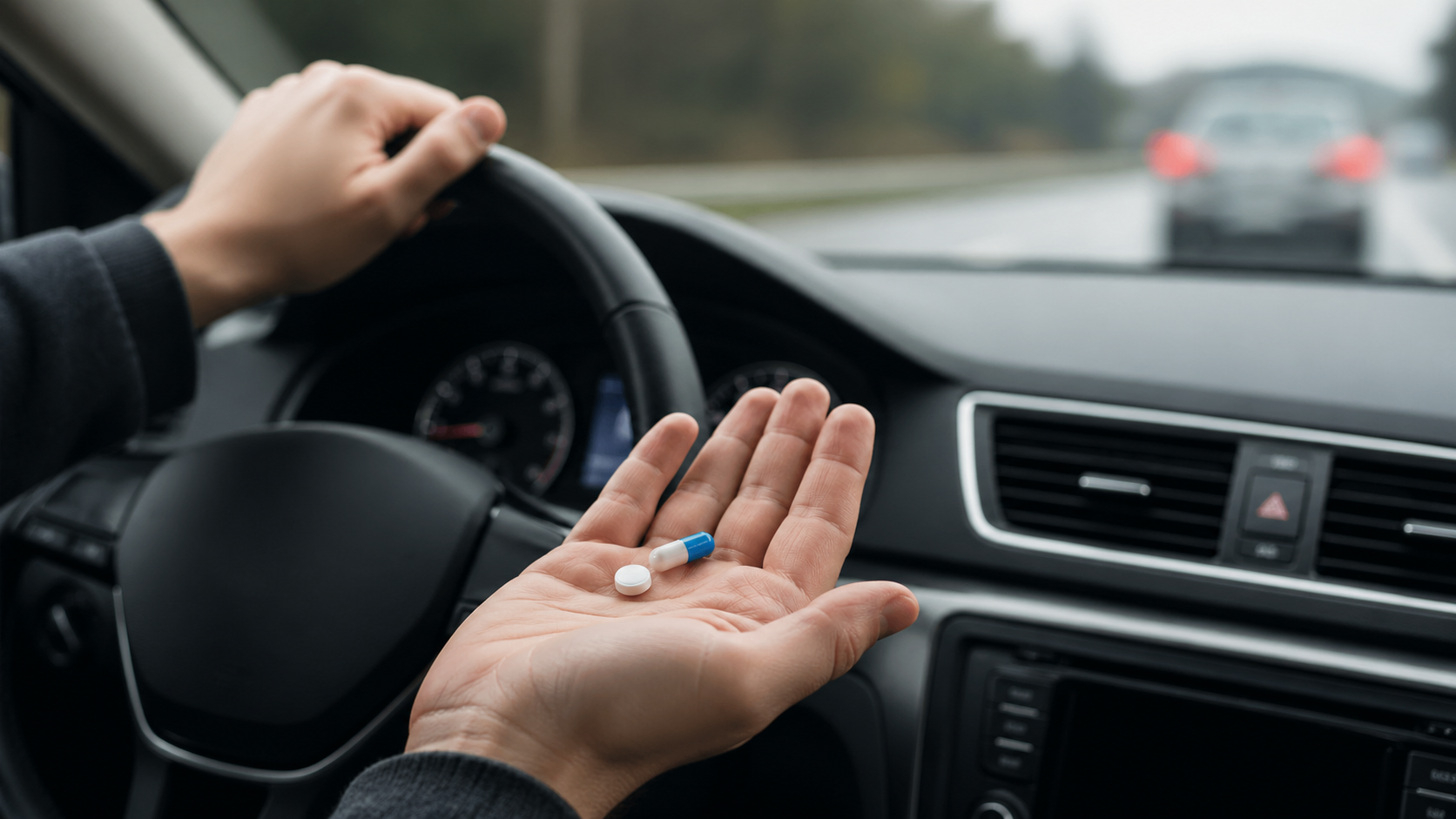
Everything you need to know about Tilidine and driving in brief:
- Tilidine is an opioid, which is usually associated with severe side effects such as dizziness, drowsiness and blurred vision, making driving generally not advisable.
- Anyone under the influence of tilidine without one medical certificate If you drive, you are committing a criminal offense and can expect severe penalties, such as fines and points in Flensburg.
- A Drug test In the case of tilidine, a traffic stop can be positive, regardless of whether the drug was prescribed by a doctor or not.
Tilidine: mode of action and application
Tilidine is a strong opioid that is particularly used to treat moderate to severe pain. It acts in the central nervous system by modulating the perception of pain and reducing the sensation of pain. The effect usually occurs within 10 to 15 minutes after ingestion and can last up to six hours. Since tilidine can also cause side effects such as dizziness, drowsiness and tiredness, you should exercise particular caution when driving and always follow your doctor’s recommendations.
The legal classification: opioid or narcotics?
Tilidine is a powerful opioid painkiller. The legal distinction is essential for drivers:

Although common tilidine preparations (combination with naloxone) are often not covered by the Narcotics Act (BtMG), this is a “false security” for drivers. The Driving License Ordinance (FeV) does not differentiate between BtM-required and normal prescription medications.
-
Appendix 4 FeV: Opioids are explicitly listed here as substances that can prevent you from being fit to drive unless you are in a stable state.
-
The potential for abuse: As soon as Tilidine is taken without a prescription or in excess of the prescribed dose, it is legally equated with illegal drugs such as heroin.
Side effects of tilidine and their effects on the ability to drive
Tilidine side effects can significantly impair your ability to drive. The danger of Tilidin behind the wheel is not just the noticeable tiredness. The following symptoms are crucial for the police during a check:
-
Limited vigilance: Attention gradually decreases, which is particularly dangerous when there is monotony (on the highway).
-
Constriction of the pupils (miosis): Like all opioids, tilidine results in very small pupils that barely respond to light. For officials, this is the classic indication of opioid consumption.
-
Distorted risk perception: The pain-distancing effect can lead to emotional indifference, which encourages risky driving maneuvers.
Legal framework for driving under the influence of Tilidine
If you take Tilidine, the legal framework for driving is clearly defined. Tilidine falls under the Narcotics Act (BtMG) and can be punished as both an administrative offense and a criminal offense if you drive without a corresponding medical certificate.
Requirements for driving ability
In order for you to be able to take advantage of the medication privilege, the following points must be met:
- Intended intake: The medication must be prescribed by a doctor and taken according to dosage instructions.
- Stable setting: The medication must be taken for a longer period of time set stable be so that acute side effects no longer occur.
- No impairment: There may not be any traffic-related failures or there is an impairment of performance below the required level (according to FeV Appendix 4).
- The opioid card (BTM card): This ID card or one detailed medical certificate must always be carried in the car. It serves the police as immediate proof of legal taking.
Expert tip: Take absolutely Contact your doctor at every traffic stop or accident to ensure medical confirmation of your fitness to drive. If this proof is missing, there are immediate consequences.
Can patients drive after taking tilidine?
The blanket answer of “no” isn’t entirely true, but the hurdles are high. A patient is fit to drive if:
-
The recruitment phase is completed: There is an absolute driving ban in the first 1-2 weeks of a new therapy.
-
There is no dose change: Any increase temporarily suspends your ability to drive.
-
Long-term therapy: In chronic pain sufferers, the body can develop a tolerance that minimizes side effects. Important: This must be supported by a specialist medical report or a performance test (reaction test).
Traffic law consequences if the driving ban is violated
If you drive under the influence of Tilidine, you risk serious traffic consequences. Without a medical certificate confirming your fitness to drive, you are committing a criminal offense in accordance with Section 24a StVG.
The impending consequences: fine, driving license, MPU
If the medication privilege does not apply (because you do not have a doctor’s certificate, you misuse it or the side effects are too severe), there are drastic penalties.
Detectability: Does the drug test react to tilidine?
Yes, Tilidin works for most people Police rapid tests (urine or sweat) because these are calibrated to the entire group of opiates/opioids.
-
Duration of detection in urine: Depending on the dose and metabolism approx. 1 to 3 days.
-
Detection time in blood: About 6 to 24 hours for the active ingredient itself, degradation products longer.
-
Important for checks: Since the test will be positive, it is important to carry it with you Opioid ID card or a medication plan is mandatory. Without this proof, the police will order a blood sample, which can immediately lead to the temporary revocation of your driving license.
Concrete danger: side effects and driving ban
The most critical point for pain sufferers is the risk that tilidine’s side effects will affect your ability to drive.
Absolute caution is required:
Conclusion
Driving under Tilidine is not taboo, but it is a legal balancing act. To minimize your MPU risk, you should:
-
Always one medical certificate (according to the model of the German Medical Association) carry the original with you.
-
Be cooperative during inspections, but respond immediately medical necessity point out.
-
Have your ability to react tested regularly so that you are not accused of “relative inability to drive” (§ 316 StGB) in the event of an accident. Our advice: Protect yourself with professional traffic psychological advice before the driving license authority asks questions.
Sources:
- Yellow list: Tilidine – ability to drive and side effects
- Thieme: Chronic pain – aspects relevant to driving safety when using opioids
- DVR: Medication and driving ability
FAQ
Is driving a car fundamentally prohibited while taking Tilidine?
Tilidine is generally considered an intoxicating substance that can impair the ability to drive and is therefore problematic in traffic. Exceptions only exist if the medication was prescribed by a doctor and there is written confirmation of fitness to drive.
Can the police detect tilidine during a check?
Yes, tilidine can be detected during a traffic stop using a rapid drug test or a subsequent blood sample. A positive result without a medical certificate usually leads to a fine and the ordering of an MPU.
Does a medical certificate help against MPU?
A certificate is an important document that proves that the intake is medically indicated and is taking place under supervision. Although it does not guarantee absolute immunity in the event of driving errors, it is often the only way to prevent MPU due to medication abuse.
Which side effects of tilidine are dangerous for drivers?
The most critical side effects include dizziness, drowsiness, severe fatigue and reduced responsiveness. These effects can mean that you can no longer react to sudden traffic events in a timely manner.
How long should you not drive after taking Tilidine?
The direct duration of action is around four to five hours, although the ability to react can be impaired for even longer. The time immediately after the start of therapy or after a dose change is particularly critical.
Does insurance pay in the event of an accident while taking Tilidine?
Comprehensive insurance can refuse coverage if taking the painkiller is viewed as gross negligence. Liability insurance usually covers the injured party, but often takes recourse against the person responsible.
Can you combine tilidine and alcohol while driving?
The combination of tilidine and alcohol is extremely dangerous because the depressant effects can massively reinforce each other. In traffic, this mixture almost inevitably leads to complete inability to drive and serious legal consequences.
What is the difference between Tilidine tablets and drops while driving?
The dosage form is secondary, as the active ingredient in both cases affects the central nervous system and reduces the ability to drive. The only decisive factor for the police and the driving license office is the detection of the active substance in the blood.
Does Tilidin lead to an entry in the criminal record?
If driving under Tilidine is considered a criminal offense under Section 316 of the Criminal Code (drunk driving), this can lead to a conviction. From a certain level of punishment, an entry is made in the police clearance certificate.
In an MPU, specific screenings are carried out that also test for opioids such as tilidine and their metabolites. Concealing the intake while at the same time having positive laboratory results will inevitably lead to a negative MPU report.